
Ukulele Lessons
Small, friendly and endlessly fun — the uke is a brilliant first instrument and a gorgeous accompaniment for singers. Lessons for kids, beginners and singer-songwriters, in London or online worldwide.
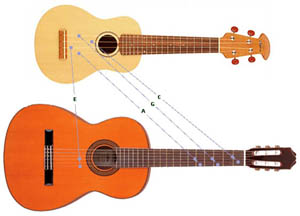
Also known as the uke, the ukulele was born in 19th-century Hawaii, found fame in the USA a century later, and spread around the world from there. It belongs to the lute family, and its four strings are tuned like the guitar’s 3rd (G), 2nd (C instead of B) and 1st (E) strings, plus a top A.
Or you could think of it as the low four strings of an eight-string guitar — G, C, E, A — but pitched higher. Smaller than a guitar and easy on the hands, it’s a favourite with kids and, as a superb strumming and vocal-accompaniment instrument, with singer-songwriters of every age.
What you could learn
on the ukulele
Chords & strumming
The joyful heart of the uke — clean chords and rhythms that swing.
Fingering technique
Clean, comfortable fretting so every note rings true.
Picking & fingerstyle
Play with the fingers for a harp-like, flowing sound.
Single-string melodies
Pick out tunes note by note, not just chords.
Songs
Learn the tracks you love — the fastest way to keep going.
Reading TAB
Read TAB as standard, plus notation if you’d like it.
For kids & beginners
We start with some basic chords and strumming patterns, then move on to melodies as you progress. For children, the soprano and concert sizes are the ones I’d suggest — comfortable to hold and easy to play.
For singers
Here you’ll also learn to play with your fingers, so the sound turns more harp- or lute-like and flows like a waterfall under your voice. Throughout, we keep a close eye on the pulse of the music — that’s what lets you sing and play at the same time without either one falling apart.
Sizes, tunings & buying tips
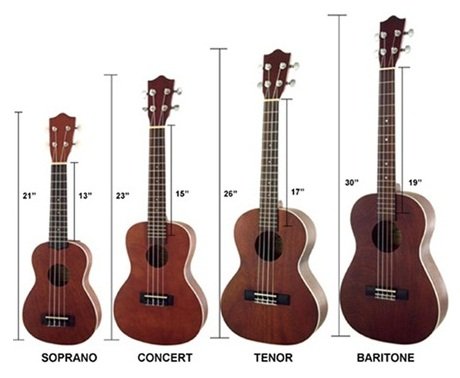
The uke’s tone and volume change with size — from the small, bright soprano up through concert and tenor to the rounder, fuller baritone. Most ukes come in standard re-entrant High-G tuning (great for accompaniment), while Low-G tuning suits guitarists switching over, as it opens up more scalar and melodic playing. The baritone is the exception, tuned like a guitar’s top 4 strings — D, G, B, E. When buying, choose one where you can see the wood: coloured varnish ruins the sound. Fun variants exist too, from the pocket uke (sopranissimo) to the U-bass and the guitalele.
Your first steps on the ukulele
The ukulele reaches a first real song faster than any instrument I teach, and month one proves it. We tune up, get a loose, relaxed strumming hand going, and learn the four chords that between them unlock hundreds of songs — C, F, G7 and A minor — with changes clean enough to keep going without stopping. Children usually get there in 3 or 4 lessons, adults often in 2.
Month two is about rhythm rather than new chords: down-up strumming, the swung feel behind most uke standards, and chunking — the muted percussive chop that makes one ukulele sound like a small band. We play in time with a backing track or with each other.
Furthermore, we move off chords and onto notes. You pick single-string melodies along the first five frets, read TAB properly, and start the harp-like campanella-style fingerpicking that lets the instrument carry a tune and its own accompaniment at once. Singers begin putting voice and hands together here — a skill of its own, and worth the time it takes.
Where the level goes after that
After the first term the routes fan out. Some students build repertoire — Hawaiian standards, pop covers, folk, a jazz standard or two — and learn to arrange a song for solo ukulele. Others go technical: barre chords, movable shapes up the neck, and Low-G tuning to open up the lower register for melodic playing. Children who started on a soprano often move up to a concert around this point, simply because their hands have grown into it.
Milestones and/or grades?
The milestones are performance rather than graded exams: your first song front to back, your first time playing and singing at the same time, your first solo arrangement, and for the youngest players, a group song they could write. If you do want something certificated however, we can follow the RGT or LCM guitar syllabi.
My daughter is very young and she really enjoys learning the ukulele from Malcolm. He is very systematic and patient especially with a child so young… If one would follow the ways he teaches, the foundation would be really strong.— Palak, parent of a ukulele student
Where lessons happen
In-studio in London SE16 — Rotherhithe, Canada Water and Surrey Quays — at your place anywhere within TfL Zone 3, including Bermondsey and Borough (SE1), Walworth (SE17), Deptford (SE8), New Cross and Peckham (SE14, SE15), Lewisham (SE13) and Canary Wharf (E14), or live online worldwide over Zoom/similar. When the weather’s kind, studio lessons can even move out to a private front-garden area. Get in touch and we’ll pick what fits you best. I teach music lessons right across South East London — see the areas I cover →.
What ukulele lessons cost
One-to-one ukulele lessons are £30 for 30 minutes or £40 for 50 minutes, in-studio or online, with four weekly 50-minute lessons block-booked at £150. Group ukulele courses come to £14 per person per session paying 12 upfront — and on the parent-and-child modules that one fee covers both of you. Lessons at your place are £40 plus a small travel surcharge. See the full fees, blocks and referral cashbacks →
Ready to strum along?
Tell me who’s playing — you or a young beginner — and what you’d love to play. I’ll get your first ukulele lesson booked.